Everyday, people disregard harmful statements, brushing them off as “just a joke.”Others passively claim “You know I didn’t mean it like that.” And a large majority blissfully ignores such things. Racism has been deeply ingrained in American society as a whole. But it’s not just America that is subject to these racist ideologies; the whole world has had these ideals building up throughout time. And as time advances, so do humans and their innovations. With the development of social media, the spread of information and communication is almost instantaneous. These developments have allowed racist rhetoric to spread easily throughout the world, being seen as normal and even comedic at times due to the nature of social media.
Racial Stereotyping
Racial stereotypes are, usually harmful, overgeneralized depictions of a group of people based on their race or ethnicity. While racial stereotyping is experienced throughout life for most people, it has become extremely common in high school. The most common form of stereotyping seen and experienced in high school is in the form of stereotypical jokes. “You’re Asian, right? So you should be good at math,” or “Of course he plays soccer, well, well, well.” Jokes like these have become a staple within younger communities at schools.. Sometimes, children don’t understand that the things they say are racial stereotypes because a joke “doesn’t count.”

One of the respondents to a survey about racial stereotyping in high school was Nataizya Ghandle, who goes to Coppell High School. She was asked “How normalized do you think racial stereotyping is in high school, and why?” She answered, “I think it’s pretty normalized, especially in schools, because people tend to just laugh it off. They want people to like them, or they just don’t care. I also think social media plays a factor into it because these stereotypes are normalized on social media. A lot of kids tend to follow social media trends and make it their personality.”
Survey Data
A survey was conducted to collect information on racial stereotypes in school to understand other students’ experiences. Over 90% of students who took the survey said they have experienced racial stereotyping in high schools, and 40% rated a 7 or higher on a scale of one to ten on how often they’ve experienced racial stereotyping. While 40% may not seem like a big number, the fact that people are still experiencing these prejudiced ideologies is shameful. Over 93% of the high schoolers who took the survey rated at least a 7 on how normalized they think racial stereotyping in high school is. When asked why, some responses pointed to media portrayals, others exclaimed dark humor and trying to be funny, or simply the fact that they’ve witnessed it up front while nobody says anything about it.
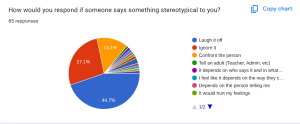
One of the final questions was, “How would you respond if someone said something stereotypical to you?” Almost half of the respondents said they would laugh it off, and only 14% said they would confront the person. Many other responses said it depended on who the person was and what the meaning behind the statement was. The idea that people don’t stand up for themselves when being racially targeted, and that being a reason as to why racial generalizations are common, exhibits correlation.
The Impact of Social Media
Social media has a huge impact on portraying racial stereotypes. Sometimes it can be in a positive manner, but usually popular media broadcasts negative portrayals. Many of the survey takers believe that social media does have a strong influence/impact on racial stereotypes. One of these respondents was Mick Laxson, a sophomore from the Law Magnet.

Mick was asked, “Do you believe social media influences high schoolers’ views on stereotypes? Why/how?” Mick responded, “I really do believe that social media influences high schoolers about their view on stereotypes. I think that there’s a lot of content out there that’s really degrading to minorities, but is played off as a joke. In my personal experience, I think these jokes are a lot more common in middle school than in high school, but I really do still think this is a pressing issue. On the other hand, I think that social media can have a positive effect on the way people view stereotypes as a whole. I believe for as much racist content there is, there’s just as much content disproving racist myths or informing people about the effects of these “jokes” on those specific minorities and the way the world perceives them.”About 78% of respondents hold that these stereotypes are harmful/hurtful. Many individuals try to defend themselves by claiming what they said was a joke, but if numerous people think they’re hurtful, these jokes can’t be considered “just a joke.”
While at first this was just a project for a class, the more I worked on it, the more I connected with this issue. While everyone may not experience racial stereotyping in the same manner, it’s still occurring in this world. Just because one doesn’t experience stereotyping and believes that “It doesn’t affect me, so it’s not my problem”, provides a powerful reason to make it your problem. Raising and spreading awareness makes a much larger positive difference than just standing by and watching does. It might start out as “just a joke,” but as time goes on, more flame gets added to the fire to the point where these jokes will be engraved into beliefs and ideals for years to come.
Sources:
https://www.cdc.gov/mmwr/volumes/73/su/su7304a4.htm
https://www.shs-conferences.org/articles/shsconf/pdf/2023/29/shsconf_icepcc2023_03014.pdf